
Ulnar Collateral Ligament Sprain (Skiers Thumb)
Imagine you are skiing on your favorite trail and, out of nowhere, the snow monster jumps up and grabs your boot. You stick your hand out to brace your fall, but your pole is still wedged between your thumb and index finger. An intense pain is felt at your thumb and, what was a great day skiing, is now a painful experience, and a trip to the doctor’s office with a case of skier’s thumb.

Skier’s Thumb, also known as “gamekeeper’s thumb,” is an injury to the ulnar collateral ligament (UCL) of the thumb. It is caused by an injury sustained by hyperabduction and hyperextension of the first metacarpophalangeal (MCP) joint. It is very commonly seen in skiers, but also occurs in other sports such as hockey, rugby, soccer, basketball, volleyball, and handball. The UCL is the main restraint to valgus stress at the metacarpophalangeal joint. If you take your hand, palm facing you, and pull your thumb away from your index finger and toward your face, the UCL prevents this motion from being excessive. After an acute injury, like described above, there can be bruising, swelling, and pain at the base of the thumb; weakness can also be felt for a short period following the injury.
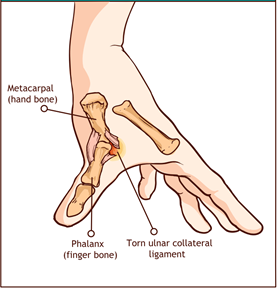
A stress test to the ulnar collateral ligament is used to see if the ligament is intact or if it is torn. Doctors can also use a variety of other tools to help diagnose this injury including a clinical exam, x-rays, ultrasounds, and MRIs. The clinical exam will give the doctor pertinent information to help make a diagnosis. X-rays are used to rule out any boney abnormality, like a fracture or a displacement of part of the bone attached to the ligament (avulsion fracture). An ultrasound is used to assess and locate the torn end of the ligament to help decide if surgical option is necessary. MRIs are considered the best modality for evaluating UCL injuries due to its ability to see soft tissue injuries and provide the most accurate information; however, it is the costliest tool and is less readily available.
If you are diagnosed with a partial tear of your UCL, your thumb will need to be immobilized in a splint or cast for four to six weeks to allow the ligament to heal back to its original position. If surgery is necessary, the surgeon will have a post-surgical protocol for you to follow, which usually includes four to six weeks of bracing as well. During the four to six weeks of immobilization, it is vital to create a proper healing environment for the thumb. Managing the swelling is an important aspect of this as edema will slow the healing process and increase pain. The use of ice and elevation can help with decreasing swelling and reducing pain. Physical therapy is usually ordered for both conservative and surgical rehabilitation to help you get back out on the snow. Physical therapists can provide modalities to aid with pain and swelling during the initial phases of recovery, like manual lymphatic drainage, Kinesio tape, and electric stimulation. Manual lymphatic drainage is a soft tissue technique used to decrease swelling and improve the lymphatics around the injured joint. The use of Kinesio tape can be for swelling reduction, pain reduction, and stabilization of the thumb. The use of electrostimulation, like a transcutaneous electrical nerve stimulation (TENS) unit, is another modality to help manage pain. Once the immobilization brace is removed, physical therapists can start with range-of-motion exercises followed by strengthening exercises to restore grip and thumb strength.
Hopefully, you never have to experience an injury like skier’s thumb, but if you do, reach out to your physical therapist at Advanced Physical Therapy for advice.
Madan SS, Pai DR, Kaur A, Dixit R. Injury to ulnar collateral ligament of thumb. Orthop Surg. 2014;6(1):1-7. doi:10.1111/os.12084 https://www.ncbi.nlm.nih.gov/pmc/articles/PMC6583257/