
Breathing

There is a famous saying that resonates very well with our topic, “proximal stability before distal mobility.” Simply put, we must have good strength and control of our trunk before we can maximize our limb function.

Being able to create a strong and stable base is something that is essential for skiers as this is the center of movement and transfer of motion and momentum from the toes to fingertips. As you push off with your foot, the force needs to be transferred up through your leg and into your trunk to maintain the momentum, then your arm swings up and plants the pole into the ground to propel even more force. The center of these two endpoints is the trunk and core.
Breathing plays a large role in this sport. Being able to engage your diaphragm is not only essential to maintaining good breathing habits and endurance, but it is part of a “fundamental six pack.” The fundamental six pack includes six muscle groups that create the foundation; not to be confused with the “sexy 6 pack,” the rectus abdominis. The “fundamental six pack” includes the diaphragm, pelvic floor, transverse abdominis/internal oblique, multifidi, latissimus dorsi, and gluteus maximus.
One technique used to engage your diaphragm while breathing is called “Belly Breathing.” To do this exercise: take a deep breath in and, as you do so, try to breathe the air into your belly instead of expanding your chest. Your belly should rise more than your chest cavity if you do it correctly. To help engage the transverse abdominis/internal oblique: gently draw your belly in as if trying to pull it away from your belt buckle. With this “abdominal draw-in maneuver,” your multifidi and latissimus dorsi will also engage naturally. To engage the pelvic floor muscles: draw in as if attempting to stop the flow of urine. It has been shown when the pelvic floor is engaged, the transverse abdominis and internal oblique activate simultaneously, demonstrating the connectiveness of these muscles (1). Physical therapists can help advance these exercises to more difficult and challenging levels as well as fine tune them to any specific dysfunction, limiting performance.
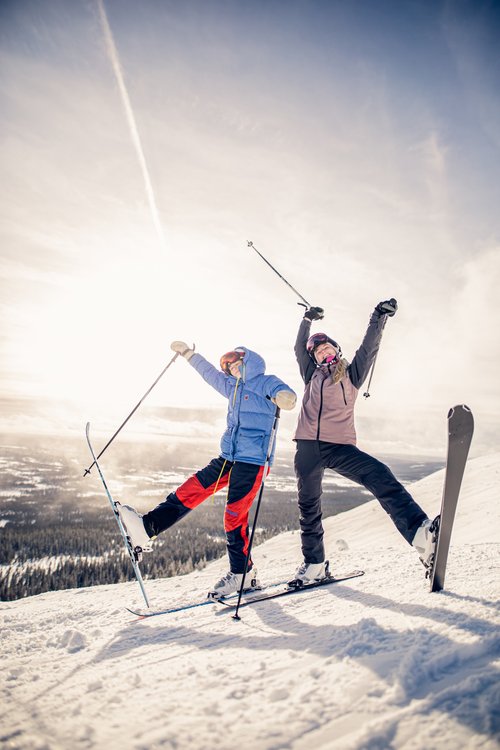
Now that you are outside, enjoy the cool winter weather and remember to engage your core while skiing. We have found that when we are moving along and feel a little off-balance, or our arms and legs are not coordinating effectively, we have turned our attention to our core muscle and, low and behold, they are not engaged. If this happens, focus on drawing your tummy away from your belt, re-control your breathing using the diaphragmatic breathing technique, and continue trucking along. If you would like to learn more exercises or techniques to strengthen your core, make sure to talk to your physical therapist.
Enjoy
Park H, Hwang B, Kim Y. The impact of the pelvic floor muscles on dynamic ventilation maneuvers. J Phys Ther Sci. 2015 Oct;27(10):3155-7